WHEN LIFE GETS DARK:
- brittbryan1001
- Nov 13, 2022
- 10 min read
Updated: Nov 15, 2022
Five Things we can do while waiting for the dawn.

I don’t know about you, but the time change messes with me every year. I get so excited to gain an extra hour of sleep when we “fall back,” but the tradeoff is that it feels like it’s time for bed at 5:00 PM. I will never understand how just one hour makes that much of a difference, but it does.
When it gets dark earlier, I just want to stay home and get under a blanket and watch old movies or do a puzzle. It makes me more introverted, which is very strange for an extra-extrovert like me. And if I allow it to happen, eventually, a little melancholy might even set in.
Darkness has a tendency to do that.

Aside from Daylight Savings Time, darkness in general has a profound effect on us. And typically, we associate darkness with something bad. For example, when describing a difficult season of life, we might say, “It was a dark time.”
In other words, we view darkness as something to avoid.
When my kids were little, they both needed night lights. Lots of us are afraid of the dark as kids, but most of us grow out of it.
But, even when I was old enough to know better, if the house was dark when I got home late at night, I would run up the stairs and into my room to get the light on as fast as possible. There might be an axe murderer lurking in the dark.
Why do we behave this way? Because there is something about darkness that we don’t trust.
And for us Christians, we receive this message loud and clear in church, as well.
We are taught God will someday do away with all the darkness in favor of the light. We ask to be delivered from the powers of darkness. We use darkness when we are talking about bad stuff like death and sin and evil.
Right there on page one of Genesis, darkness is pit against light. We immediately learn the earth was formless and void and darkness covered the waters. Then God said, “Let there be light!” And he saw that it was good, so he separated the light from the darkness. And there you have it: Light = Good. Darkness = Bad.
Our faith, perhaps in an attempt to provide a certain level of comfort, often supports the notion that darkness is something we want to avoid.

When it comes to darkness, the messaging is clear: we ought to get through the darkness as fast as possible so we can get to the light.
And yet, light makes no sense without darkness. Which makes me wonder...
What if darkness is not all bad?
I once heard someone talk about how we will inevitably experience dark periods of life. They said, "When this happens to you, it’s normal to feel defeated and discouraged. Just don’t set up camp there.”
And I love that. I love that phrase, “Don’t set up camp there.”
But the more I thought about it, the more I thought, hmm…that’s just another way of saying we need to escape the darkness as fast as possible and find the light.
Which led me to this thought:
Maybe, sometimes, we actually SHOULD set up camp.

To be clear, I don’t think we should hire a real estate agent to help us find our forever home in the darkness.
But camping is temporary. I think that’s an awesome metaphor for dark seasons of life. They don’t last forever, they’re uncomfortable, but they can also teach us things we would never learn if we always slept comfortably in the safety of our homes.
So, I figured I’d run with this metaphor and suggest Five Things we can do with darkness when it appears we will be camping there for a time.
1. Be prepared.
When you set out to go camping, you bring only the essentials with you. Unless you’re MacGyver, or Bear Grylls, you cannot possibly be prepared for every single possible scenario. So, you prepare the best you can.
Cheryl Strayed’s memoir Wild is about her experience hiking the Pacific Crest Trail. Strayed describes how she packs her backpack full of everything she thinks she'll need, which turns out to be way too much for her to carry. She literally cannot even lift the bag, much less carry it.
So she has to decide, what can I leave behind? What MUST I take with me?
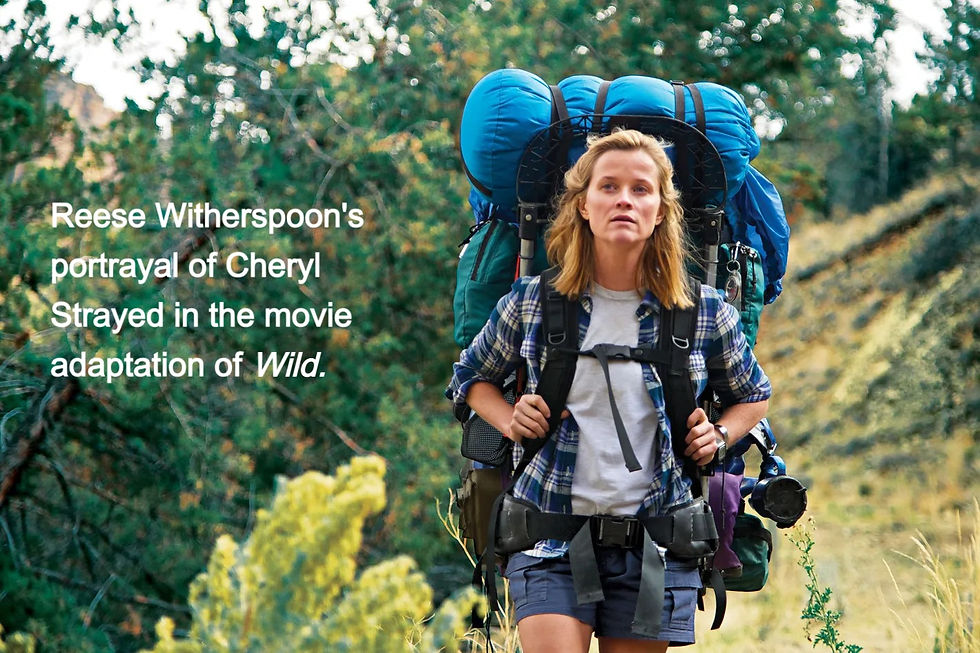
Strayed writes, “I was amazed that what I needed to survive could be carried on my back. And, most surprising of all, that I could carry it.”
So, when it comes to preparing for dark seasons of life, you really only need the essentials:
A belief in your own ability and strength to survive it.
A belief in something bigger than your limited self, for the times when you’re not entirely sure you’ve got what it takes.
A good guide to help you navigate it. Which brings me to my second point.
2. Bring a Guide.
Bear Grylls can go out into the wilderness on his own and survive any life-threatening scenario. We are not Bear Grylls.
He does have lots of survival advice, though. So, if you are in need of a guide through the literal wilderness, he's your guy.
Among the most important advice he gives is to tell someone where you are going. If no one knows where you are and you find yourself in a bad spot, your chances for receiving help are basically zero.
So, talk to others about your wilderness - the struggles you’re going through. Don’t go it alone.
If, however, you insist on setting out on your own, at least bring a guide.
Does anyone drive anywhere today without Waze or Apple Maps? Like, how did we get anywhere before this technology?
I’ve worked at the same place for seven years. I know the way pretty darn well. But I still use Waze every single day to get to and from work. Not because I have short-term memory loss and cannot seem to remember the route, but because Waze will update me with events on my usual route and tell me if I should go another way this time. (Also, not gonna lie, the notifications about where police might be hiding does come in handy…)
The point is that Waze helps lead me to my destination in a much safer and more efficient way than if I relied merely on my own sense of direction.

The route I used to drive every morning is now blocked with construction, so I had to learn a new way. Life does that to us sometimes. Your safe and well-known path is suddenly blocked, and you can either refuse to leave your house, or you can consult a guide and learn a new route.
There are numerous options for a guide through metaphorical darkness. Maybe it’s a trusted friend or therapist or family member. Maybe it's your God or your Holy Book. Maybe it’s the Twelve Steps or meditation or fasting. It just needs to be something other than you alone.
For me, the Bible is my roadmap. It’s full of wisdom for how to navigate the tough stuff of life. It’s full of encouragement and hope that everything will be made right.

It's my belief that if you go through life with the Bible as your guide, following Jesus, you’re going to be led to safety. It might be the scenic route, and it might not even be the destination you had in mind, but you can trust that you’ll end up where you need to be.
*An important note about letting the Bible be your guide: make sure you are using sound interpretations and translations and that you have a pastor/spiritual mentor who knows what they’re talking about. The Bible, in the wrong hands, can also lead you down the wrong path. So, just make sure you choose your guide wisely.
3. Lose the distractions.
Often when we are dealing with hard stuff in life, we want to distract ourselves from the discomfort. Do you know the number one thing that distracts us?
Light.

We are absolutely inundated with light.
City lights and headlights that never sleep, illuminating the dark with our constant busy-ness and perpetual productivity.
Light emanates from our computers and devices with their endless text, email, and social media notifications, capitalizing on our severe FOMO.
Light floods our rooms from streaming services on our smart(mouthed) TV screens.

Sidenote: Whose BAD idea was it to add a “Screen-Time” option on our iPhone settings? Rude.
Let me be clear: I love technology. I just think it’s problematic when we use it to distract ourselves from what we really ought to be dealing with. When it becomes a buffer against the darkness as a form of avoidance.
Because we are constantly distracting ourselves with light from these sources, we are never truly in the dark. And if we begin to feel something like a darkness creeping in, we immediately go to one of those sources to fix that. Maybe see what is trending on TikTok, or go to Amazon to have a solution delivered in 1-2 days.
We do whatever it takes to keep light going so we don’t even sense the darkness.
But when you’re camping, you cannot really use any of that technology to distract your mind from the things you want to escape. And that’s a good thing. It means you get to search your mind and heart to learn things about yourself you otherwise wouldn’t and couldn't know.

My uncle loves to go backpacking. Several years ago, he hiked the entire Appalachian Trail. I recently asked him why does he do it? Why does he love backpacking so much?
He said, “Nature is that primeval calling that all of us have deep within our souls. When I’m out there, it fulfills that longing.”
I don’t think I have that exact same longing, but there is something about nature that calls to our innermost being, precisely because it gets us away from that which distracts us.
But we don’t have to literally go camping to achieve that - we only have to disconnect from the distractions long enough to reconnect to ourselves.

4. Look for beauty.
It’s time for me to make a confession: I actually hate camping.
If by “camping” you mean a comfy bed in an air-conditioned room with my own bathroom and shower, then I’m in. Otherwise, I would not go camping unless you paid me. Like A LOT of money.
I didn’t always feel this way, though. In my younger days, I loved to go backpacking.
What I loved most was the night time, when the entire sky was stretched above me and I could see all the stars I never knew were there before.
That’s the thing about stars. How well you see them depends on your location. They aren't visible in our polluted city spaces, but go out west, or to the top of a mountain, or to the beach, and they're endless. Stars need a vast dark backdrop for them to stand out.
So, if we can't see the stars, it doesn't mean they’re not there. It just means we need to change our location to get a better view.
We must put ourselves in the way of beauty to see it.

In her book Learning to Walk in the Dark, Barbara Brown Taylor makes the point that new life always starts in the dark. Think of a seed planted inside soil, or a baby inside a mother’s womb. They begin in the dark. So, if we avoid the darkness, we will inevitably miss out on new life.
Strength and beauty often follow pain. Broken bones grow back stronger. We fundamentally understand this truth. We just don't live like it.
Our response to pain, when we lose hope and become immobilized, seems to indicate that we actually don’t understand that truth at all. We look at our problems and our pain and we search for someone to blame, or we lament that life is unfair.
And sometimes it is unfair. That’s when it’s up to us to find beauty in the darkness.
The Cellist of Sarajevo is a powerful story about just that.

photo cred: https://www.bbc.co.uk/programmes/p06w9dv2
During the Bosnian War in 1992, a bomb went off near civilians waiting for food in a bread line, killing twenty-two people.
The next day, cellist Vedran Smailović put on his tuxedo - black tie and tails and all - and played concerts inside the bomb craters and collapsed buildings all over Bosnia. Twenty-two concerts, to be exact. One for each of the lives lost in the bombing. Beautiful.
It’s easy to find beauty in our lives when things are going according to our plan. It’s admittedly harder to find beauty when we are surrounded by darkness.
But it is possible.

Beauty is everywhere all the time waiting to be discovered. We only need to have eyes to see.
Eyes that see the potential for something beautiful to come from the bombed out craters of our lives.
Eyes that are willing to search beyond the darkness, beyond the destruction, beyond our present pain. Beyond ourselves.
Eyes that have been trained to remember that it is always darkest just before the dawn.
Eyes that look for ways to be in the way of beauty.

5. Break camp.
After you’ve learned all you can in the darkness, there will come a time when you need to break camp.
Maybe you brought only the essentials with you when you arrived. But as you prepare to leave the camp site, make sure you pack the things you learned during your time in the dark.
Pack the guides that helped you along your way through the darkness. Take those with you on your next journeys.
Pack the strength you didn’t know you had before. Take that with you into the next season of life.
Pack the perspective you gained from going through this painful experience. Take that with you into your future conversations with others who are going through something similar.
Pack the beauty you discovered all along the way. Take that with you as a reminder that while it may be dark in the night, joy always comes in the morning.
And most importantly, pack the knowledge you now have that our greatest struggles lead to our greatest strengths. Take that with you everywhere you go.

One final thing to say about our perception of darkness. Just remember that darkness held Jesus for three days before his resurrection. But darkness could not keep him.
Our temporary seasons of darkness will pass, and we can rest in the knowledge that while we are in them, he is with us.
“Even though I walk through the darkest valley, I will fear no evil, for you are with me.” -Psalm 23
Books I mention in this blog:


Comments